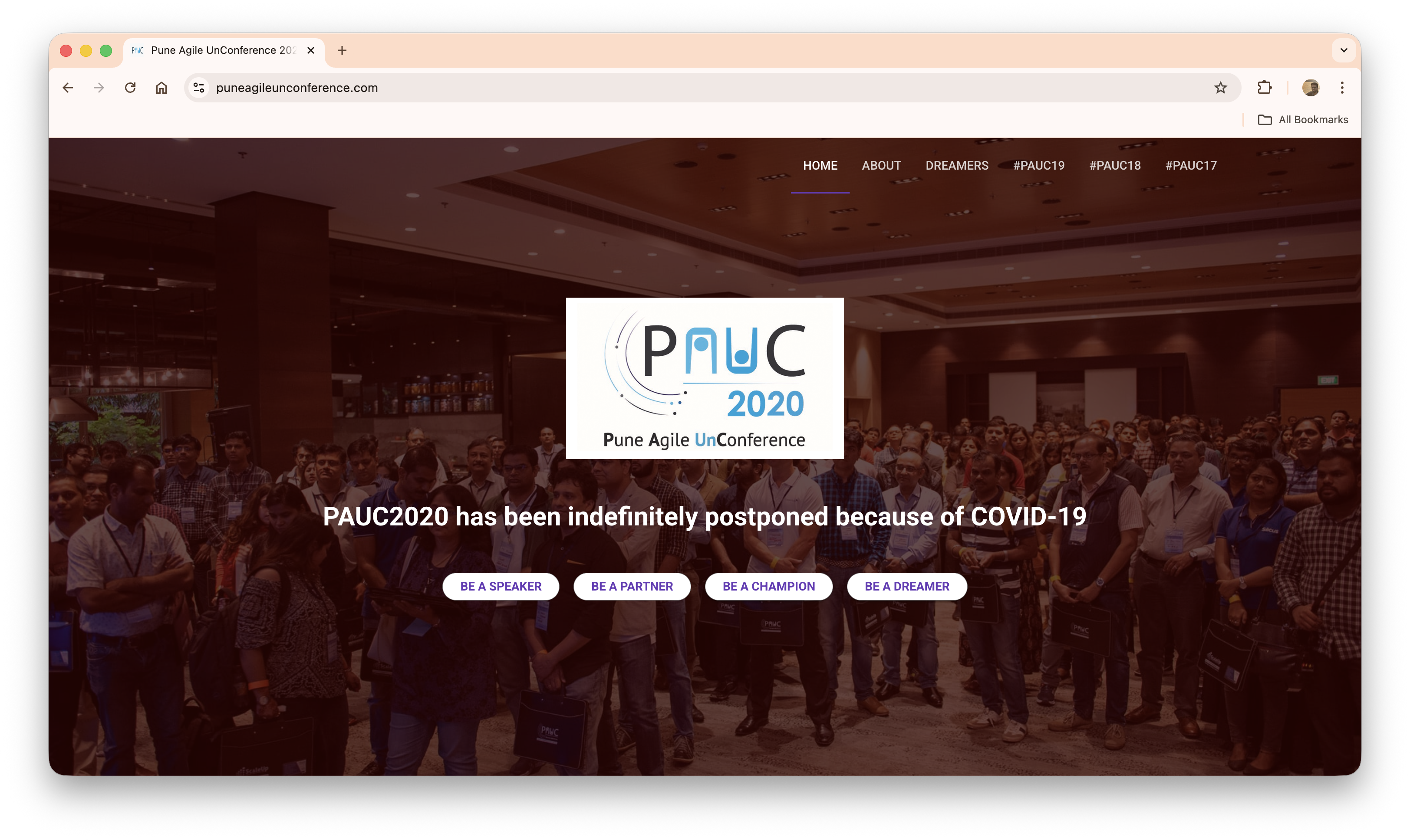
The Context
The Pune Agile UnConference (PAUC) is an annual gathering of Agile professionals and enthusiasts - one of the leading community events working to establish Pune as the Agile Capital of India. Each year, the event needed a professional website: the primary information hub for registration, speaker profiles, session schedules, and announcements.
As part of my freelance work with ScaleUp Consultants Pvt. Ltd., I became the technical owner of the PAUC website for three consecutive years. And rather than maintaining a single static site, I rebuilt it from scratch each year - each time with a more capable tech stack.
Year-by-Year Evolution
2018 - The Foundation
Stack: HTML5 · CSS3 · JavaScript · GoDaddy Hosting
The first iteration was built with clean, standards-compliant HTML and CSS. No frameworks, no CMS - just a well-structured, responsive site that gave the event a credible digital presence from day one.
Focus: Accessibility, clarity, cross-device responsiveness.
Infrastructure: GoDaddy shared hosting.
2019 - The CMS Evolution
Stack: WordPress · PHP · Elementor · Google Tag Manager · Google Analytics · AWS EC2
As the event grew, the organizers needed to update content themselves - speakers, session details, venue information - without touching code. WordPress with Elementor gave the non-technical team editorial independence while I maintained technical quality.
I created custom WordPress post types for sessions and speakers, enabling structured content management that powered the schedule and speaker profile pages dynamically.
Focus: Content management flexibility, SEO, analytics visibility.
Infrastructure: AWS EC2 for improved performance and control.
2020 - The Modern Rebuild
Stack: Polymer Web Components · Material Design · Firebase Hosting
The 2020 iteration adopted Google's Polymer library for web components - a forward-looking architectural choice that resulted in a modular, reusable, and highly performant frontend. Material Design principles gave the site a polished, contemporary visual identity.
Focus: Performance, interactivity, component-based architecture.
Infrastructure: Firebase Hosting for fast, globally distributed delivery.
Consistent Across All Three Years
Despite the technology changes, several things remained constant:
- Session & speaker presentation - clear, filterable schedule and speaker profile pages
- Mobile responsiveness - every version worked flawlessly across desktop, tablet, and mobile
- SEO optimization - structured metadata, canonical URLs, and on-page optimization to drive organic discoverability and registration traffic
- Hosting & domain management - SSL configuration, DNS management, and reliable uptime throughout each event cycle
- Organizer support - training non-technical organizers on CMS tools; providing ongoing content updates and technical support throughout the event season
Technical Architecture Highlights
Progressive Technology Adoption
Each year's rebuild wasn't just a cosmetic refresh - it was a deliberate step toward more capable, maintainable architecture. Static HTML → CMS-driven → Component-based represents a meaningful progression in how the site was built and operated.
Performance Optimization
Across all three versions: image optimization, lazy loading, browser caching, and platform-appropriate CDN configurations ensured fast load times during the peak traffic periods around event registration and day-of announcements.
Analytics & Conversion Tracking
From 2019 onwards, Google Analytics and Google Tag Manager were integrated to give organizers visibility into traffic sources, registration funnel performance, and session interest patterns.
Impact & Takeaway
Three years with the same client, each year a better product. The PAUC website engagement grew alongside the event itself - driven by consistent improvements in performance, SEO, and user experience.
The project also demonstrates something important about freelance technical work: longevity and trust. The organizers came back year after year because the work was reliable, the communication was clear, and each iteration genuinely moved the needle.
Three years. Three stacks. Static HTML → WordPress → Polymer. One event's digital presence, always improving.
Tags: agile conference · event website · unconference · agile methodology · conference management · event registration · community platform · professional development